
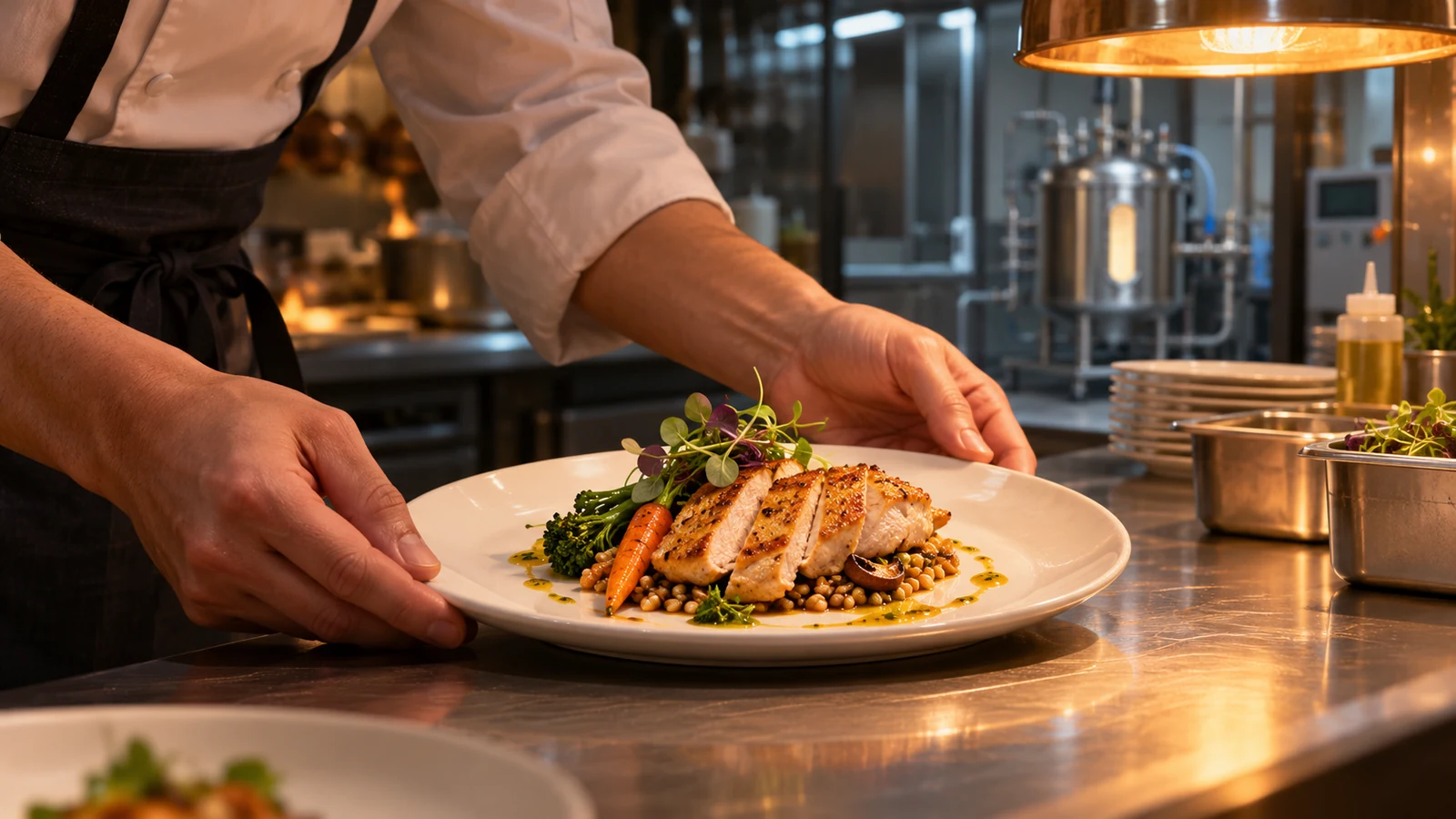
UPSIDE Foods is putting cultivated chicken on more California menus. That makes the technology easier to taste, but it does not settle the harder question: can cultivated meat become an ordinary, affordable food business rather than a limited restaurant experience?
UPSIDE’s location page lists restaurant availability in Los Angeles and San Francisco, with additional San Francisco locations marked as arriving November 18. The company’s November 17 rollout announcement describes corporate and college dining programs and restaurant sales. Those are concrete access points, not evidence that the product is broadly stocked, cheap or produced at mainstream poultry scale.
A menu listing is a real milestone—and a narrow one
For consumers, restaurant availability means the product has moved beyond a lab demonstration. It also exposes the product to a practical test: would someone order it again at the price, portion and location actually offered? For chefs, the question is whether supply and quality are dependable enough to build a dish around.
Availability at selected restaurants cannot answer either question for the whole market. A restaurant rollout may involve small volumes, special partnerships and a customer willing to try something new. Those are reasonable early-stage conditions, but they should not be mislabeled as evidence that cultivated chicken has solved manufacturing economics.
Regulatory clearance is not a scale claim
Federal food-safety review matters because it establishes a route for a product to be sold. It does not determine whether a company can build enough bioreactor capacity, obtain inputs reliably or compete with conventional chicken on cost. Readers should distinguish permission to sell, actual output, geographic availability and profitable repeat demand.
UPSIDE benefits from a visible proof point and partner restaurants gain a differentiated menu item. Conventional meat producers may face a new long-term competitor, while diners bear the early-adopter price and uncertainty about whether a limited offering will persist. Neither side needs exaggerated claims: new food technology can be meaningful before it is mass-market.
The evidence that would make this a bigger story
Look for independently verifiable production volume, sustained menu availability, transparent pricing, repeat orders and new facilities operating at commercial scale. A press release can establish the company’s launch plans; it cannot by itself demonstrate a durable cost advantage or environmental outcome.
For now, the reader takeaway is simpler. If a nearby restaurant lists cultivated chicken, it is an opportunity to evaluate a real product. It is not a reason to assume the grocery aisle or everyday food budget is about to change.
Frequently Asked Questions
Where can people find UPSIDE cultivated chicken?
UPSIDE’s location page lists selected restaurants in Los Angeles and San Francisco. Check the restaurant and UPSIDE directly because menus and availability can change.
Is cultivated chicken widely available in supermarkets?
This rollout concerns food-service locations and institutional programs. It does not establish broad supermarket availability.
Does regulatory clearance mean cultivated chicken is cheap to make?
No. Regulatory review and manufacturing cost are separate questions.
Is a restaurant launch proof of mass production?
No. A limited launch can be important without demonstrating high-volume, profitable production.
What should diners look for?
Look for clear menu information, price, serving format and current availability. Treat personal taste as a personal experience, not evidence about industry-wide scale.